How to use the state minimum lookup
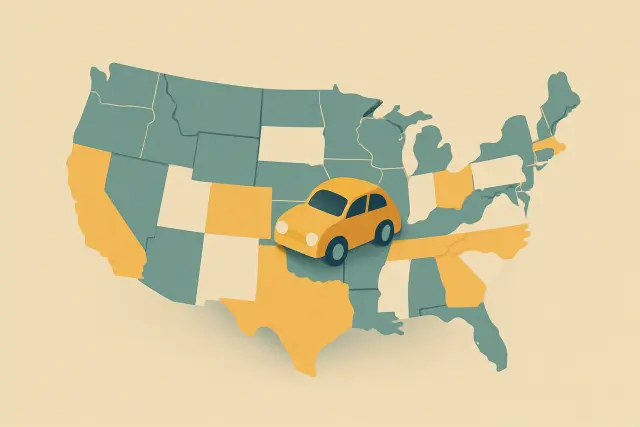
Pick your state from the menu. The tool shows the minimum liability limits, any required personal injury protection (PIP), other coverages the state requires and whether it is a no-fault state. You do not need to enter any personal details.
Use the results as a checklist. Put them next to the declarations page (the summary page at the front of your policy that lists your coverages and limits) or next to a new quote. Every number on your policy should be at least as high as the matching number here.
What the results mean
Each result answers a different question:
| Result | What it pays for | Who it protects |
|---|---|---|
| Bodily injury, per person | Medical bills and other losses for one person you injure | Other people (and your savings) |
| Bodily injury, per accident | The total for everyone you injure in one crash | Other people (and your savings) |
| Property damage | Repairs to other cars, fences, buildings and poles | Other people’s property |
| PIP | Your own and your passengers’ medical bills and some lost wages | You and your passengers |
| Uninsured motorist (UM/UIM) | Your injuries when an uninsured or underinsured driver is at fault | You and your passengers |
A “yes” under no-fault means your own PIP pays first for injuries after a crash, whoever caused it, and lawsuits for pain and suffering are limited unless injuries pass a threshold. Our no-fault vs at-fault states guide explains how this works state by state.
Second example: a choice between two states
State rules that change the answer
A few states work very differently from the usual pattern:
- New Hampshire does not require most drivers to buy insurance, as of October 2026. Drivers must still be able to pay for damage they cause.
- Florida requires $10,000 of PIP and $10,000 of property damage liability but not bodily injury liability for most drivers (Florida Statutes 627.736 and 324.022, 2025 edition). Our Florida car insurance requirements guide covers the exceptions, such as FR-44 after a DUI.
- California raised its minimums to 30/60/15 on January 1, 2025, according to the California DMV.
- Some states require uninsured motorist coverage, and others require insurers to offer it so you can turn it down in writing.
Special filings change the numbers too. An SR-22 or FR-44 is a form your insurer files to prove you carry coverage after certain violations, and it can require higher limits than the normal minimum.
Common mistakes
- Treating the minimum as a recommendation. It is the least the law accepts. A serious crash can cost more than minimum limits, and you can be responsible for the rest.
- Keeping old limits after a move. Your old policy may not meet your new state’s rules.
- Forgetting your own car. No state minimum pays to fix or replace your car. That needs collision and comprehensive coverage.
- Assuming every quote uses the same limits. Ask for identical limits on each quote, then compare prices with our quote comparison worksheet.
- Relying on an old number. Several states changed minimums in 2025 and 2026. Check the as-of date and your state insurance department.
When should you carry more than the minimum?
If you own a home, have savings or earn a steady income, higher limits protect more of what you have. Our liability gap calculator shows what your limits would pay in a sample crash and what could be left for you to pay. For the full state-by-state table and what each coverage does, read our state minimum car insurance guide.
How the lookup works
Behind the menu is a table with one row per state and Washington, DC. Each row holds the bodily injury limits, the property damage limit, any required PIP amount, flags for required uninsured or underinsured motorist coverage, and a no-fault flag. When you choose a state, the tool reads that row and formats the numbers in dollars. Nothing is estimated or averaged, and no personal data is used or stored.
Each row was checked against the state insurance department, DMV or statute when we last reviewed it, and the as-of date in the results shows that review. When a state passes a law that changes its minimums, we update the row and the date. If you see a difference between this tool and an official state page, trust the state page and let us know at so we can correct it.
Questions to ask before you buy
The minimum tells you what is legal. These questions help you decide what is right for you:
- What do I own that a lawsuit could reach? Savings, a home and future wages are all at stake if a crash costs more than your limits.
- Would I want help with my own injuries? If your state does not require PIP, ask about medical payments coverage or PIP as an option.
- Do many drivers in my area go uninsured? Uninsured motorist coverage protects you when the other driver cannot pay.
- How would I replace my car? If you could not afford to replace it out of pocket, ask about collision and comprehensive coverage.
- How much more do higher limits cost? Ask for prices at two or three limit levels. The difference is sometimes smaller than people expect, but only real quotes show it.
Write the answers down and use them when you request quotes, so every insurer prices the same coverage.